

Reincarnation, also known as rebirth or transmigration of the individual soul (Jivatma), is the fact that an individual soul continues to exist after physical death and is reborn into a new life. The principle of karma – the idea that one’s actions in past lives influence their present and future existences. The cycle of birth, death, and rebirth, known as samsara, is considered endless until one attains spiritual liberation. 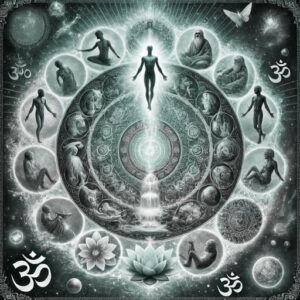
Suffering, or dukkha, is an inherent part of the reincarnation cycle. Though life consists of few blissful moments, larger portion is painful. Both feelings are temporal. According to the Vedic scriptures, suffering arises from various factors, including:
- Karma: Wholesome or unwholesome actions in past lives lead to corresponding consequences in future lives. Your actions are accounted and are defined in three types: Sanchita (good or bad deeds accumulated in past lives), Prarabda (results you bring from current deeds or earlier birth), and Agami/Kriyamana (the deeds you are accumulating in this birth)
- Ignorance: Lack of understanding or misperception of reality leads to suffering.
- Attachment: Desiring and clinging to things that are temporary and unreliable can result in suffering.
- Aversion: Resistance to unpleasant experiences and circumstances also leads to suffering.
The relationship between reincarnation and suffering is intricate:
- Suffering because of past karma: Reincarnation implies that suffering/joyfulness in this life is a result of past actions or karma.
- Suffering as a catalyst for spiritual growth: Suffering can serve as a motivator for spiritual growth, encouraging individuals to seek liberation from the cycle of reincarnation.
- Reincarnation as a means to exhaust karma: Through multiple lifetimes, individuals can exhaust their accumulated karma, eventually leading to liberation by approaching a realized soul, the Guru who can impart complete wisdom of this word and the absolute.
To break free from the cycle of reincarnation and suffering, various spiritual traditions offer paths, such as:
- Karma Yoga: Selfless action and service to others can help exhaust karma.
- Jnana Yoga: Spiritual knowledge and self-inquiry can lead to liberation.
- Bhakti Yoga: Devotional practices, such as meditation and prayer, can help cultivate a deeper connection with the divine.
- Raja Yoga: Cultivating mindfulness and practicing meditation can help reduce suffering and increase spiritual awareness.
Though reincarnation is a fact, the individual souls are in transmigration from one body to another body of various kinds of species and it is inevitable until one gets liberation from this bondage of samsara. Evolution and involution occur simultaneously and are inherent to the nature of souls. Ameba, a single-celled organism to the complex human being, evolution continues, and degradation from human life to insect life will be based on one’s own karma. Throughout this process, suffering and enjoyment is involved in Jivas. While some view reincarnation as an opportunity for spiritual growth, others see it as a cycle to be transcended. On the whole, one has to get liberation from the cycle of births and deaths to avoid suffering and to get eternal bliss.
Liberation is seldom achieved overnight; rather, nirvāṇa unfolds gradually as one uproots deeply ingrained defilements like ignorance. Lord Krishna’s teachings in the Bhagavad Gita emphasize that suffering stems from forces such as desire (Kama), anger (Krodha), and greed (Lobha), which must be diligently countered through ethical conduct, meditation, and insight. Often, progress on this spiritual path is subtle, and the transformation may not be immediately evident in daily life.
The cycle of births and deaths is fueled by accumulated karma, attachments, and habitual mental patterns; if liberation seems elusive, it may be because these entrenched conditions have not yet been sufficiently transformed, signaling the need for further practice to weaken their grip. Reflecting on one’s current practices—whether consistent meditation, self-inquiry, or ethical living—can reveal if systematic approaches are in place, as many teachers warn that even a slight remaining tendency toward craving/attachments can perpetuate the cycle of samsara. To nullify samsara, one must put forth the effort to remove its cause by realizing the oneness of the Brahman with the world and relinquishing the false ego that will be the cause of the rebirth.
Moreover, personal struggles along the path can often be eased by seeking guidance from a knowledgeable Guru or a supportive spiritual community, as mentors can help identify and adjust subtle obstacles that might otherwise go unnoticed. Many advanced practitioners share that, after long periods of steady practice, moments of insight arise unexpectedly, gradually softening attachments and deepening mindfulness until liberation manifests instantaneously—not as a future event, but as an immediate realization. Feeling that liberation has not yet been achieved is not a failure; it is an indication that the transformative work is ongoing.
Ultimately, liberation—or moksha—is essential because it ends the inherent suffering, limitations, and persistent dissatisfaction of samsara, allowing the soul to transcend the pain, desire, and decay of physical existence and realize its true, divine nature. In attaining liberation, one transcends the ceaseless cycle of birth and death to experience eternal peace, bliss, and unification with the ultimate reality, living in the presence of an unchanging, eternal truth beyond the fluctuations of worldly joy and sorrow.
Time calculations as per the Vedas
In Vedic tradition, time is perceived as an eternal and cyclical phenomenon, encompassing both infinitesimal moments and vast cosmic periods. The Vedas and subsequent texts, such as the Manu Smriti and the Surya Siddhanta, provide detailed frameworks for measuring time, ranging from the smallest units to expansive epochs.
Micro Units of Time:
- Truti: Considered the smallest unit, a truti is defined as the time taken for 1/1687.5th of a second, approximately 0.4 microseconds.
- Vedha: 100 trutis constitute a vedha.
- Lava: 3 vedhas make up 1 lava.
- Nimesha: 3 lavas equal 1 nimesha.
These subdivisions continue, leading up to a kastha, which is approximately 1.6 seconds, and further aggregations culminate in larger units like the ghatika (24 minutes) and the muhurta (48 minutes).
Macro Units of Time:
The Vedic system also describes extensive time cycles:
- Yuga: A cycle comprising four ages—Satya Yuga, Treta Yuga, Dvapara Yuga, and Kali Yuga—collectively spanning 4.32 million years.
- Mahayuga: A grand cycle of 1,000 yugas, totaling 4.32 billion years.
- Kalpa: A day in the life of Brahma, the creator deity, equivalent to 4.32 billion years and a night equivalent to 4.32 billion years. A divine year of Bramha is 8.64 x 360 days = 3110.4 billion earth years.
- Maha Kalpa: Mahakalpa is equal to 100 divine years which is equal to 311.04 trillion earth years.
In Hindu cosmology, the lifespans of deities are described in vast time scales. According to the Shiv Puran, the lifespans of Brahma, Vishnu, and Shiva are interrelated, with each successive deity’s lifespan being seven times longer than the previous. Here’s a breakdown:
- Lord Brahma:
- Lifespan: 100 divine years.
- Calculation:
- One day of Brahma (a Kalpa) equals 1,000 Chaturyugas (cycles of four yugas).
- Each Chaturyuga totals 4.32 million human years.
- Thus, one day of Brahma equals 4.32 billion human years, and his night is of equal length.
- A month consists of 30 such days, and a year comprises 12 months.
- Therefore, Brahma’s total lifespan is 100 divine years, which translates to an immense number of human years.
- Lord Vishnu:
- Lifespan: Seven times that of Brahma.
- Calculation:
- If Brahma’s lifespan is considered as one unit, Vishnu’s lifespan is 7 units.
- This means Vishnu’s lifespan is 7 times 100 divine years of Brahma, equating to 700 divine years.
- Lord Shiva:
- Lifespan: Seven times that of Vishnu.
- Calculation:
- Following the same pattern, Shiva’s lifespan is 7 times that of Vishnu.
- This results in 7 times 700 divine years, totaling 4,900 divine years.
These calculations illustrate the hierarchical and expansive nature of time in Hindu cosmology, emphasizing the grandeur and longevity attributed to these deities.
Achalayoga imparts unshakable and complete wisdom of the Brahman (the world), enabling practitioners to distinguish between the Absolute Brahman (Achala Paripurna Brahman or the Absolute) and the Brahman (space-time continuum) which is the causation of the world. This profound understanding of both Brahmans facilitates the unification of individual soul (Jiva/ Kshara Purusha) and universal soul (Brahman/Akshara Purusha) and nullifies false ego, recognizing that Brahman and the universe are identical and indistinguishable. The spiritual and material worlds are intricately connected and are two sides of the same coin. Attaining this knowledge not only leads to liberation (moksha) from the cycle of births and deaths, but also enriches one’s life’s journey and contributes meaningfully to society on both material and spiritual levels. 
The New York Achalayoga Foundation is committed to fostering universal harmony, mutual cooperation, and both material and spiritual advancement for all. Our teachings guide individuals toward liberation from the cycle of rebirth, leading to eternal bliss—the ultimate human aspiration.
Those who fully embrace the wisdom shared by this Foundation can free themselves from illusions and misconceptions. A superficial understanding of existence cannot resolve life’s endless questions or dispel subjective and objective delusions. True mental stability is not achieved through blind faiths or unscientific beliefs but through deep spirituality. This spiritual awakening is rooted in the teachings of the ancient book, the Bhagavad Gita which is the purport of all the Vedas and the Upanishads.